
Garage Door Closes Then Immediately Reopens: Causes & Fixes
Last updated:
By Literally Garage Door Team | Northern NJ garage door experts with years of hands-on experience serving Bergen, Essex, Morris, Passaic, and Hudson counties.
Published: February 16, 2026
Your garage door goes all the way down, hits the floor, then immediately reverses back up. Here's why it happens and how to fix it.
Why Does My Garage Door Close Then Reopen?
This is one of the most frustrating garage door problems; and one of the most common calls we get at Literally Garage Door. Your door travels all the way down, touches the floor (or gets close to it), then immediately reverses back to the open position. You press the button again, same thing. Over and over.
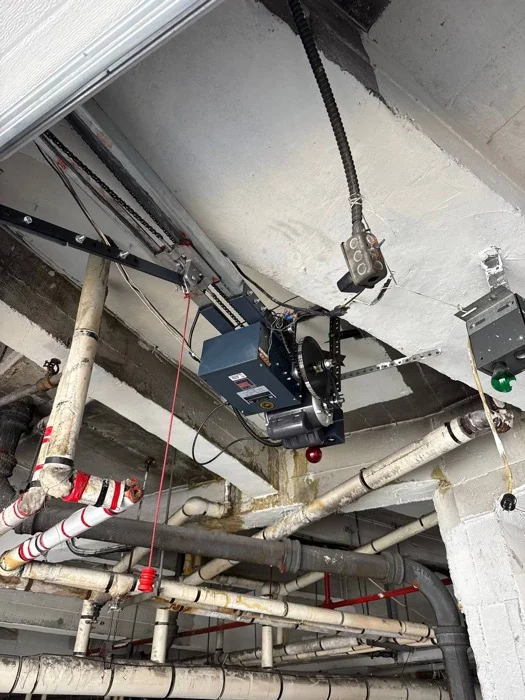
The good news: this is almost always fixable, and it's rarely an expensive repair. The bad news: there are several possible causes, and diagnosing the correct one requires understanding how garage door safety systems work.
Understanding How Your Opener Decides to Reverse
Modern garage door openers (any unit manufactured after 1993) have two independent safety systems that can cause the door to reverse:
- Photo-eye sensors: Two small sensors mounted near the bottom of the door frame on each side. They project an invisible infrared beam across the opening. If anything breaks this beam while the door is closing, the opener reverses immediately. This prevents the door from closing on people, pets, or objects.
- Auto-reverse force sensing: The opener monitors the resistance (force) the door encounters while closing. If the door meets unexpected resistance, hitting an object, a binding track, or even the floor too hard; the opener reverses to prevent damage or injury. This is controlled by the "close force" and "close limit" settings.
When your door closes then reopens, one of these two systems is being triggered. Here's how to figure out which one:
Cause #1: Close Limit Is Set Too Far
What's happening: The opener's close-limit setting tells the motor how far to drive the door down. If this setting is too far, the door reaches the floor and the motor keeps trying to push it further. The door pushes against the floor, the opener detects excessive force, and triggers the auto-reverse.
How to identify it: Watch the door carefully as it closes. If it touches the floor smoothly but then immediately reverses (without any sensor light flashing), the close limit is likely the issue.
The fix: Adjust the close-limit setting on your opener. Most openers have adjustment screws on the back or side of the unit labeled "CLOSE" or "DOWN." Turning the screw slightly (usually 1/4 turn counterclockwise) shortens the travel distance. This is a delicate adjustment, small turns make a big difference. If you're not comfortable, call a technician.
Cause #2: Close Force Is Set Too Low
What's happening: The close-force setting controls how much resistance the opener will tolerate before reversing. If set too low (too sensitive), even normal resistance; the door's weight settling against the floor seal, triggers a reversal.
How to identify it: The door closes, seems to hesitate or slow right at the bottom, then reverses. There may be a slight "bump" as it reverses.
The fix: Increase the close-force setting slightly. The adjustment screw is usually next to the close-limit screw. Turn it 1/4 turn clockwise. Test. Repeat if needed. Be careful not to set it too high; the force must remain low enough to reverse if the door encounters a real obstruction.
Important safety test: After adjusting force, place a 2x4 flat on the floor in the door's path. The door should reverse when it contacts the board. If it doesn't, the force is set too high and needs to be reduced.
Cause #3: Misaligned Safety Sensors
What's happening: The photo-eye sensors at the base of the door frame are misaligned, dirty, or malfunctioning. When the beam is broken or unstable, the opener may let the door travel most of the way down (some openers allow partial travel with degraded sensor signal) then reverse at the last moment.
How to identify it: Check the indicator lights on both sensors. One should have a steady green light (sending unit) and one a steady amber/orange light (receiving unit). If either light is off, flickering, or blinking, the sensors aren't communicating properly.
The fix:
- Clean the lenses: Wipe both sensor lenses with a soft cloth. Dust, cobwebs, and grime can interfere with the beam.
- Check alignment: Both sensors should be pointing directly at each other and at the same height. Even a slight tilt can break the beam. Loosen the wing nut on the bracket, adjust until both lights are steady, then retighten.
- Check for sunlight interference: Direct afternoon sunlight can overwhelm the sensor's infrared beam. A simple cardboard shade or repositioning can solve this.
- Inspect the wiring: Check for damaged, pinched, or disconnected wires running from the sensors to the opener. Lawn equipment, stored items, and foot traffic can damage these wires over time.
Cause #4: The Door Is Binding or Off-Track
What's happening: If the door encounters physical resistance; a bent track, a worn roller, a binding hinge, or minor off-track alignment; the opener's force sensor detects the extra resistance and reverses the door.
How to identify it: Watch and listen as the door closes. Do you hear scraping, grinding, or see the door hesitate at a specific point? Does one side move slower than the other? These are signs of a mechanical issue.
The fix: This requires professional diagnosis. A binding door could be caused by worn rollers, a bent track, a failing cable, or an off-track condition. Adjusting the opener's force setting to overcome the resistance is NOT the answer; it masks the underlying problem and defeats the safety system.
Cause #5: Worn Opener Gears or Drive
What's happening: If the opener's main drive gear is partially stripped, it may be able to move the door down but lose traction at the bottom when the door meets floor resistance. The gear slips, the door bounces, and the opener interprets this as an obstruction and reverses.
How to identify it: Listen for a grinding or clicking sound from the opener motor unit while the door is in motion. This is different from track-level noise; it comes from above, from the opener itself.
The fix: Opener gear replacement or, if the opener is old, a full opener replacement.
When to Call a Professional
If you've tried cleaning sensors and checking alignment but the problem persists, call a professional. The issue may be electrical (wiring, logic board), mechanical (binding, off-track), or a combination. We diagnose the exact cause and fix it right, typically in one visit.
Related
- Garage door opener repair
- Garage door repair
- Door reverses when closing
- Off track repair
- Roller repair
For more information, read our complete garage door repair guide.
Bergen, Essex, Hudson, Morris, Passaic, Sussex, Warren, Union and Somerset Counties.